
Inflation Increases in October, Worsening Recent Trend
Peter Bernstein, Chief Economist pbernstein@rcfecon.com, 312-431-1540 x1515
Louise Collis, Senior Economist
November 10, 2026
The Current Situation
The CPI All Items rose 0.4% in October, after a 0.6% rise in September. Core inflation (which excludes food and energy) rose 0.3% in October which is the same as last month. The BLS did not report year-on-year numbers today because the government shutdown prevented collection of data in October 2025. Based on an estimate of October 2025 price levels, year over year increased to 4.0% compared with the 3.7% rate in September. Similarly, core inflation rose from 2.6% to 2.8%. The past three months have been particularly bad with overall CPI rising 5.7% on an annualized basis, with core inflation at 3.7% over the same period.
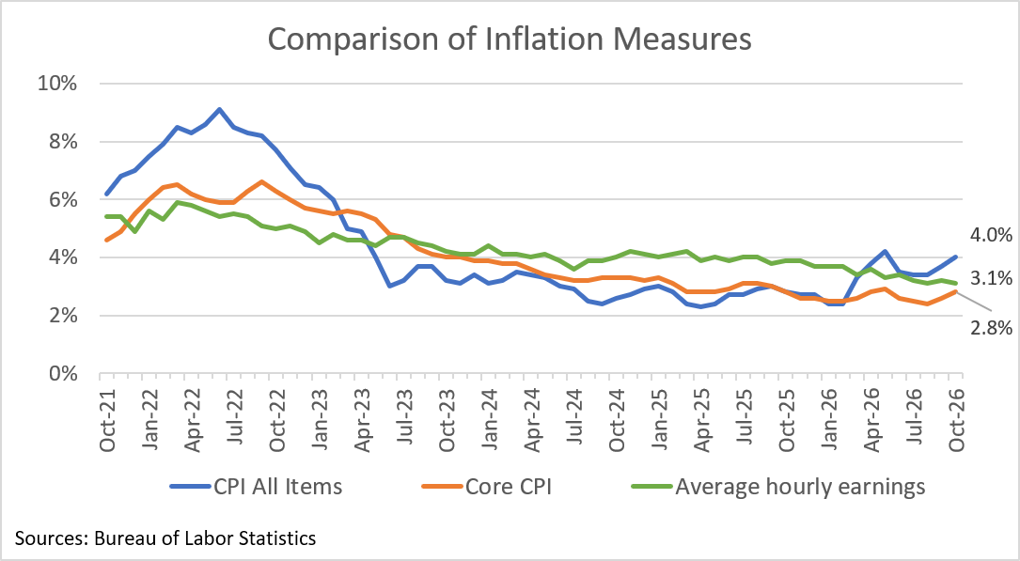
As inflation has accelerated to 4%, workers’ wage growth has declined to 3.1%. Inflation has exceeded wage growth for seven consecutive months. Households are coping, and consumer spending continues to grow but at the expense of reduced savings which has fallen to its lowest level since 2022. And many households aren’t saving anything at all. According to data from the NY Fed, credit card debt has neared $1.3 trillion, and the credit card delinquency rate has risen to Great Recession levels.
October’s inflation data ensure that the Fed will be raising rates in December, and likely into next year as well. The hope is that before long higher interest rates will result in a decline in inflation. But for indebted households struggling with rising prices, there may be more pain before they see any gain.
RCF’s Inflation Scorecard
RCF’s Inflation Scorecard is based on analysis of 20 different price series comprising 98% of the total consumer price index. Each of these price series represents a portion of the CPI based on household spending patterns. For example, food purchased for at-home consumption is about 8% of the typical consumer’s budget; it has a weight of 8.33 out of a total index of 100.
Our scorecard presents two metrics to track month-to-month price increases. The first metric is the share of the index for which inflation in the most recent month is rising (greater than the prior month’s inflation) vs. the share of the index for which inflation is falling (lower than the prior month) or prices fell (deflation).
RCF Inflation Scorecard: October 2026
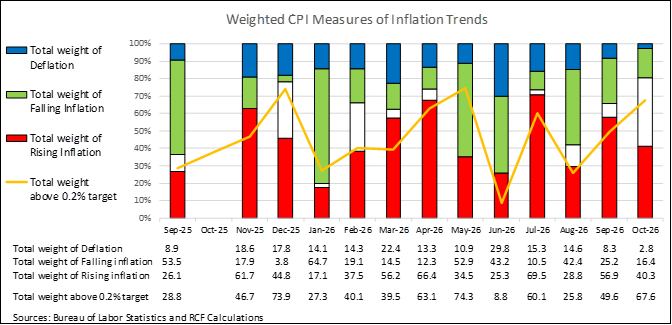
Our scoreboard shows in October, 40% of the weighted CPI showed rising monthly inflation vs September. Only 3% of the weighted CPI saw deflation, the lowest share of falling prices since 2022. Another 16% had a lower monthly price increase in October than September. Many of the series we track saw no improvement. The three-month trend in this metric is disheartening. Back in August, 57% of the weighted CPI had deflation or falling inflation. In September, that figure was 33%; in October it was only 19%.
Our second metric is the share of the weighed CPI that had monthly inflation above 0.2%, a level that corresponds to the Fed’s 2% annual target. 68% of the weighted CPI had inflation above target. While this is not the highest in the last year, this means that things are going in the wrong direction.
Analysis of Individual Components of the Consumer Price Index
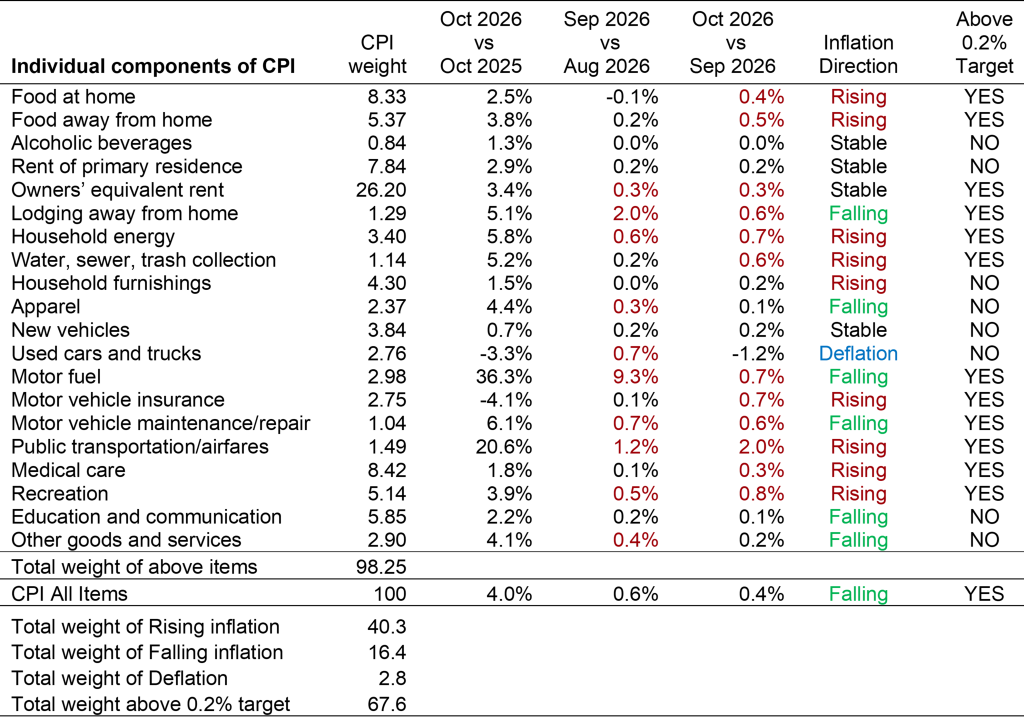
Sources: Bureau of Labor Statistics and RCF Calculations 1. Year-on-year calculations use an interpolated value for October 2025. Inflation direction indicates whether monthly inflation in October was higher or lower than monthly inflation in September. Deflation means prices fell in October vs September.
Highlights:
- Food at home prices rose 0.4% in October after falling in September. They are up 2.5% vs. a year ago. Food away from home increased 0.5% in October and 3.8% from last year.
- Motor fuel prices increased 0.7% in October. That doesn’t sound bad after September’s reading of up 9.3% in a month, but it’s still up 36% over the past year. Public transportation/airfares, for which fuel is a major input, continue to increase and are up 2% for the month, and up 21% from a year ago.
- Household energy prices rose 0.7% for the month after an increase of 0.6% last month. Prices are 5.8% higher than a year ago. Fuel Oil is up a staggering 78% since last year.
- Rent and owner’s equivalent rent are up 0.2% and 0.3% respectively in October, the same readings as in September. Year over year, they are both up 3%. Shelter which also includes lodging away from home is up 3.4% for the year.
- New vehicles are up 0.2% for the month, the same as last month. Used cars and trucks are down 1.2% and are the only category in our scoreboard that showed deflation for the month. Motor vehicle insurance prices are up 0.7% in October but down 4% for the year.
